The Ebbing's silverberries (elaeagnus ebbingei) are now definitely ripe, and I picked a quart of them this morning:
 I'm going to have to reverse my former opinion of these silverberries, and rank them very high as a wild food. Ripe berries in March! It's incredible. Those that are red and firm have a slight acid astringency and the flavor of lemon. When they're ripe they soften and almost liquefy into a raspberry/strawberry jam - very, very good. It only took me an hour to pick this quart. The berries still have large pits, so only the rind is edible - but it is very tasty.
.
We did our second wild edible plant walk at the Chattahoochee River NRA yesterday. I brought the silverberries I'd gathered in a beargrass basket for everyone to try. It's amazing how this coiled basket I made years ago still smells intensely of fresh beargrass. It takes me instantly back to camping in the Gila, gathering the fresh wands of beargrass above the hot spring. The rim of the basket is willow:
.

We had light rain on and off so no flowers were out for our walk. This is too bad because one part of the trail goes through a small ravine, which before was covered in flowers such as bloodroot and trillium and toothwort - very Appalachian. Bloodroot flowers covered the entire hillside. There is also a lot of spicebush in flower, with their fragrant twigs.
.
We found plenty to eat on our two hour walk. There were silverberries, unripe Oregon Grapes, redbud flowers; I pulled a young cattail shoot out of a swamp for everyone to try - there are several cattail swamps; we sampled weeds like chickweed and speedwell and onion and dead-nettle. We had a few dandelion flowers, some spiny thistle that was rather strong, violets; the earliest blueberry in flower, large bushes right off the river with tons of white pendant urn-shaped blueberry flowers; red maple keys, black greenbriar berries (carrion flower), rose hips still red from the year before, and young rose leaves . . . we found a lot of elderberry in leaf, both at the river's edge and up in the forest; lots of red buckeye (poisonous), and I dug up the little underground bud of heartleaf (a birthwort). Spring is an exciting time.
.
Here's one silverberry shoot weighed down with the clusters of silverberries:
.
 And Mishka loves them!
 He begged and begged to try some. I finally gave him a bunch in a bowl because I was sick of hand-feeding him. He eats them pits and all. It is actually natural for dogs to eat berries - they're omnivores. Coyotes will not only eat berries when they're ripe, they'll eat all the bear scat after the bear's eaten berries - this was something I witnessed camping long-term up on Pigeon Mtn. I even came across a coyote chasing a turkey once down the dirt road.
.
Mishka first discovered berries up at Graveyard Fields in August. We camped there for a couple of weeks, and every morning we gathered 6 cups of berries for our morning oatmeal. Mishka would watch us gathering and eating some. He would whine to be fed. So we'd give him some. But eventually it gets old feeding him, and you're like - they're all around you dog, and at your height, go eat! Eventually he did. He even waded in to the thorny blackberry and ate and ate till his fur had lots of juice stains.
.
.


 These were so good! Heavy and filling, but simple, and high-enzyme. Here's how I made them:
 We went to the Chattahoochee River NRA to see what edible plants we can find for Sunday's wild food walk. I wasn't expecting much other than what I'd found in the bottomlands along the river. However, it turned out to be a jackpot for common edible lawn weeds. This is one strip along a fence, at the edge of a parking lot:
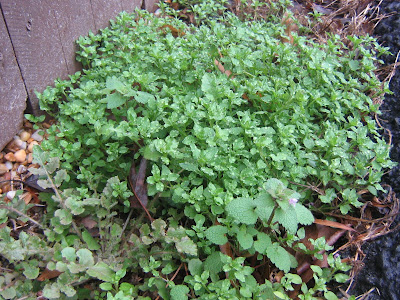 And the dead-nettle around objects the mower couldn't reach:
 Here's a plant I couldn't identify, no matter how long I pored over field guides and later the internet:
 Parsley is incredibly nutritious. This is from A2Z OF HEALTH:
 Incredibly, incredibly satisfying. This is made from 1 cup of filtered water, 2 ripe bananas, a ripe mango, and organic collard greens. The secret I realized was in blending the mix on high for an additional 30 seconds, until every last trace of leaf bit is blended in. I was always worried about getting the mix too hot from blending, but this 30 seconds on high hardly heats it up at all. In fact it all remained cooler than room temperature as the water was cold.


 I ran the seeds through twice to get them into mush. I added a little Real Salt. I ate this for a while with celery, then remembered we have some small seedy tangerines in the fridge. I juiced 4 of these and put it in the blender with my tahini mush. This had a great flavor, though not the usual tahini consistency - it was more wet. But afterwards my stomach hurt and I felt like I ate way too much.
 Today is my second day eating 100% raw and I gathered dandelion flowers for my green smoothie. I picked about 40 to 50 of them. You just pluck the flower and pinch off the green base, so that there is no white sap left on the flower (the sap is very bitter). It's important to do this before they go in the bag, or sap leaking out of the green stems will get on the flowers and make them bitter. Process them on the spot, then place them in your gathering bag or basket.
 There are varying levels of pollutant exposure for roadside plants. One factor is whether the plant is perrenial or annual. Perrenials get it the worst, because they're there year after year, soaking it up. Another factor is whether the soil is downhill or uphill from the road. If it's downhill contaminants from the road wash into it over and over, and are absorbed in the roots. Typically it is flowers and fruits that are the least affected, especially flowers considering how short-lived they are. And in general the poisons in the roots don't migrate up into the flowers and fruits. The leaves are so-so. They often get quite a bit of particulate matter dumped on them. Washing them in water tends to only remove 1/3 of the pollution.